Travel Blog
Greenland: Day by Day
Chasing aurora over frozen fjords and ice-locked mountains
Reykjavík & Transit — 10 February
Arrival & First Promise
My journey to Greenland began with an Iceland Air flight from London to Keflavík and a night at the Aurora Hotel beside the airport — a deliberately low-key start before heading deeper into the Arctic. I went out for a 5km run in the cold evening air, running from the hotel to Keflavik harbour and return, a small ritual of clearing the mind before what lay ahead. It felt like standing in a doorway, one foot still in the familiar world.
That evening, a soft green aurora shimmered above the hotel — subtle, gentle, unhurried. It was less a display than a suggestion, a whisper of what might come over the weeks ahead.
Ilulissat — 11–15 February
Into Ilulissat
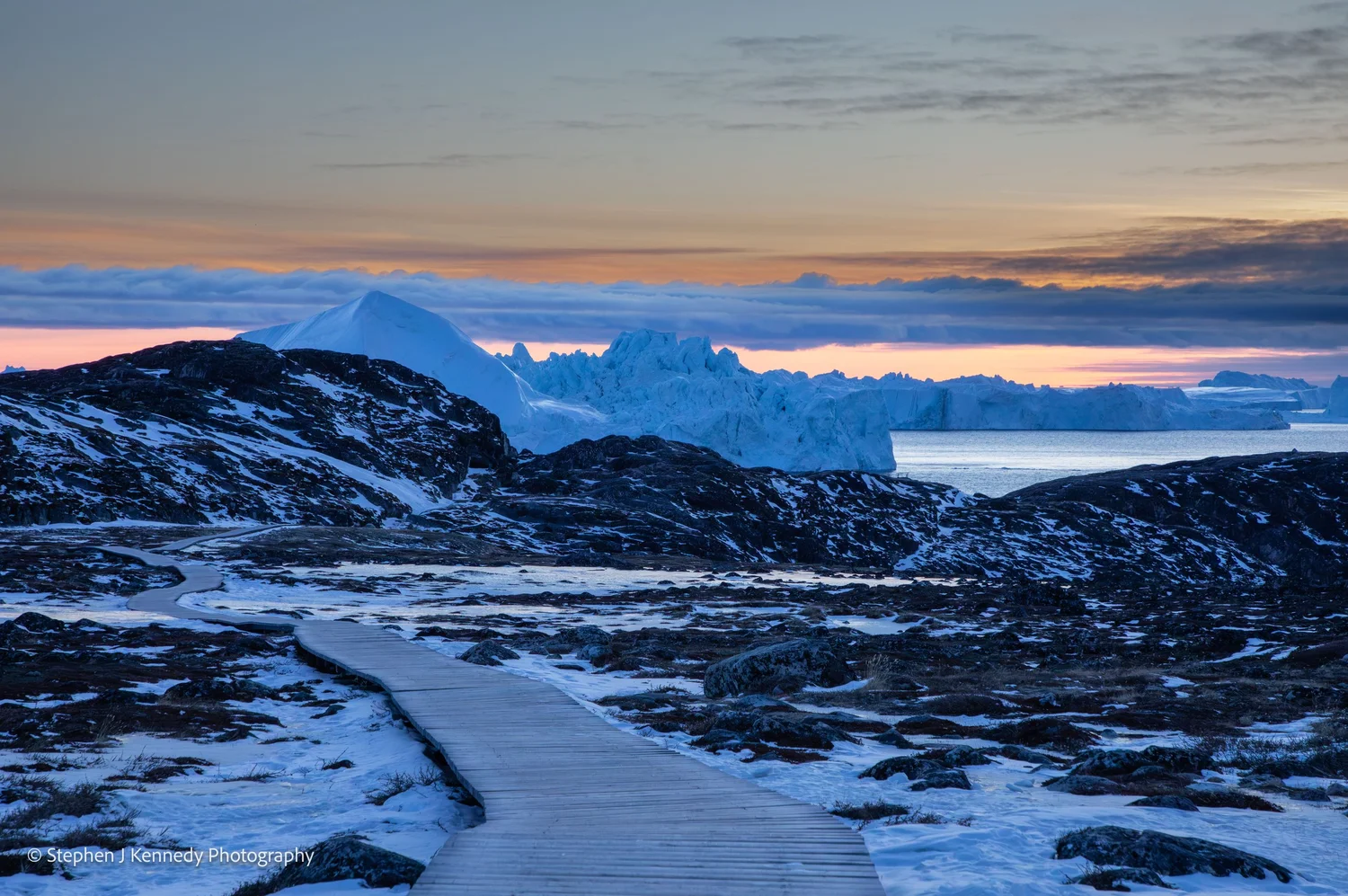
Two further flights — Keflavík to Nuuk, then onward to Ilulissat (via Aasiaat) with Air Greenland — carried me steadily north and west, the landscape below slowly emptying of everything except white. Ilulissat means "icebergs" in Greenlandic, a name so perfectly literal it feels almost like a dare.
That evening I walked the boardwalk in front of the Icefjord Hotel, taking in the calm of Disko Bay, with ice bergs in the distance and the lights of Ilulissat. I photographed my first Greenland aurora from the hotel boardwalk that night, the first of many to come.
Ice & Apprenticeship
An early start for aurora photography over Ilulissat town from the Icefjord hotel boardwalk — the cold immediate and unambiguous at a wind chill near −20°C. To adjust camera settings, my fingertips had to leave their gloves for a few seconds at a time, and each time they stung as if they'd been burned. The lesson came quickly: snood up, work fast, protect your skin before the numbness starts to lie to you.
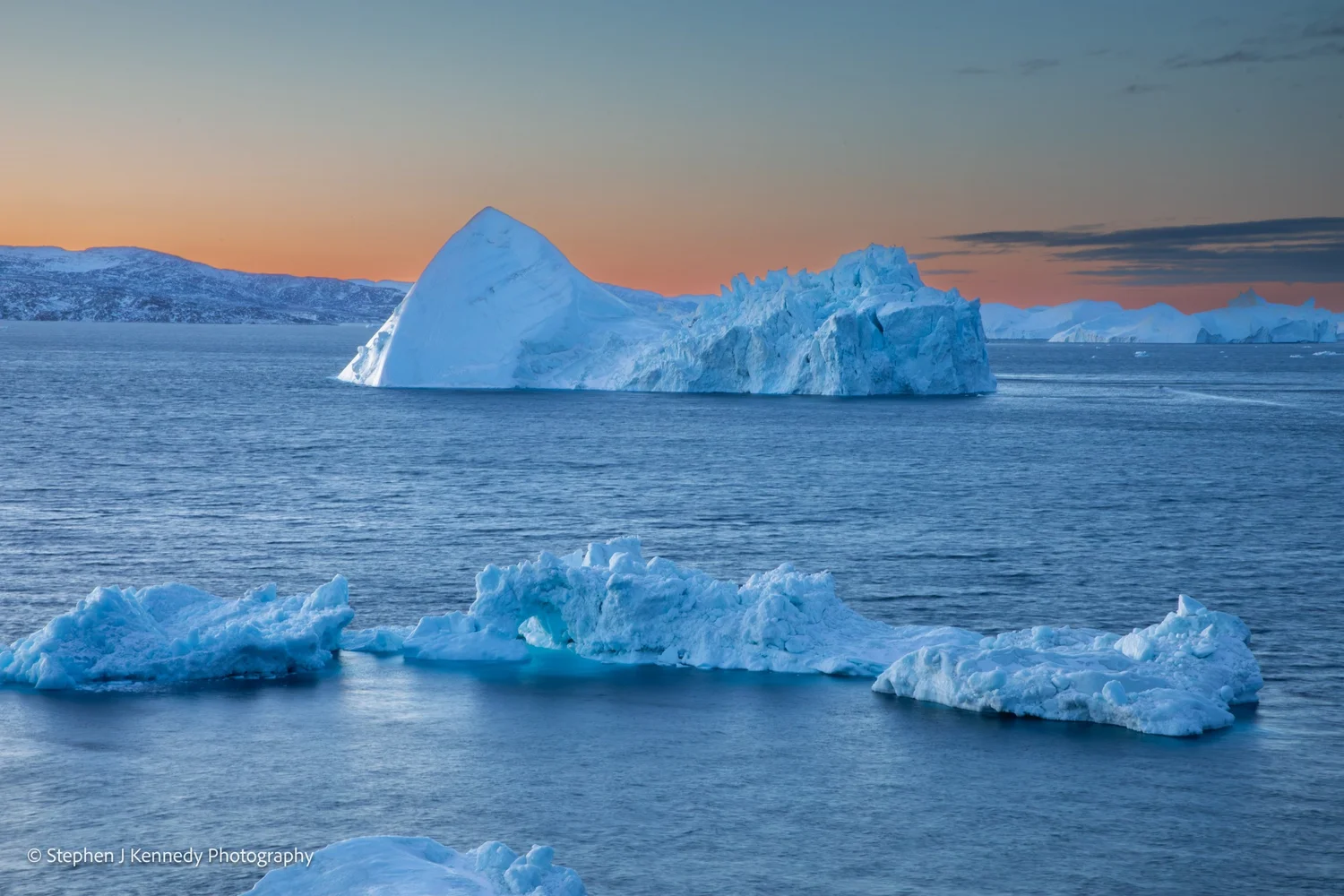
Dawn approached and I followed the Yellow Trail out toward the Icefjord park, where icebergs towered in Kangia fjord in extraordinary stillness. The pre sunrise light was amazing, accentuating the blues of the ice-bergs offset by the pink in the sky. In the course of venturing for a morning iceberg composition, I went off trail, and I missed the trail markers entirely. As a result, I found myself scrambling down a stony slope and across a stretch of sea ice before regaining the boardwalk to the Icefjord centre. It was a small misadventure, but it set the tone for something I'd come to understand more fully over the weeks ahead — Greenland rewards attention and punishes the lapse of it.
Cloud & Coffee
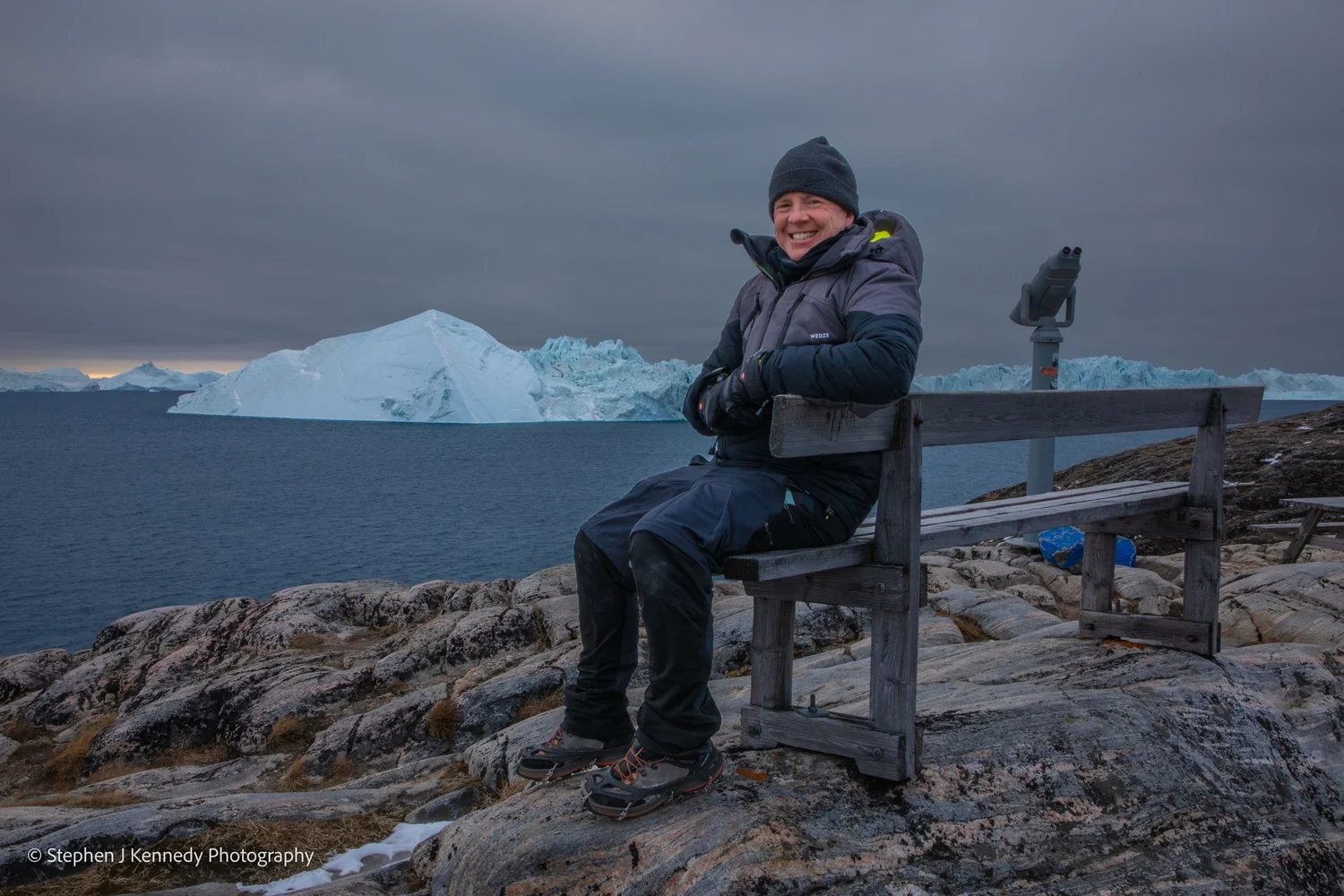
A day of overcast skies and muted light, which shifted the rhythm from photography to walking. I took the Red Trail and returned via Blue, moving at a slower pace through the landscape, and was rewarded with the brief appearance of a snow hare — white against white, visible only because it moved. Also, it was too fast for me to train my telephoto on it. Coffee at the Icefjord Centre, with its friendly staff, became something of a ritual, a point of warmth between exposures to the cold. The nearby sled dogs stirred at dusk as the sky darkened, but the cloud held and there was nothing to photograph that night.
First Night at the Icefjord Centre
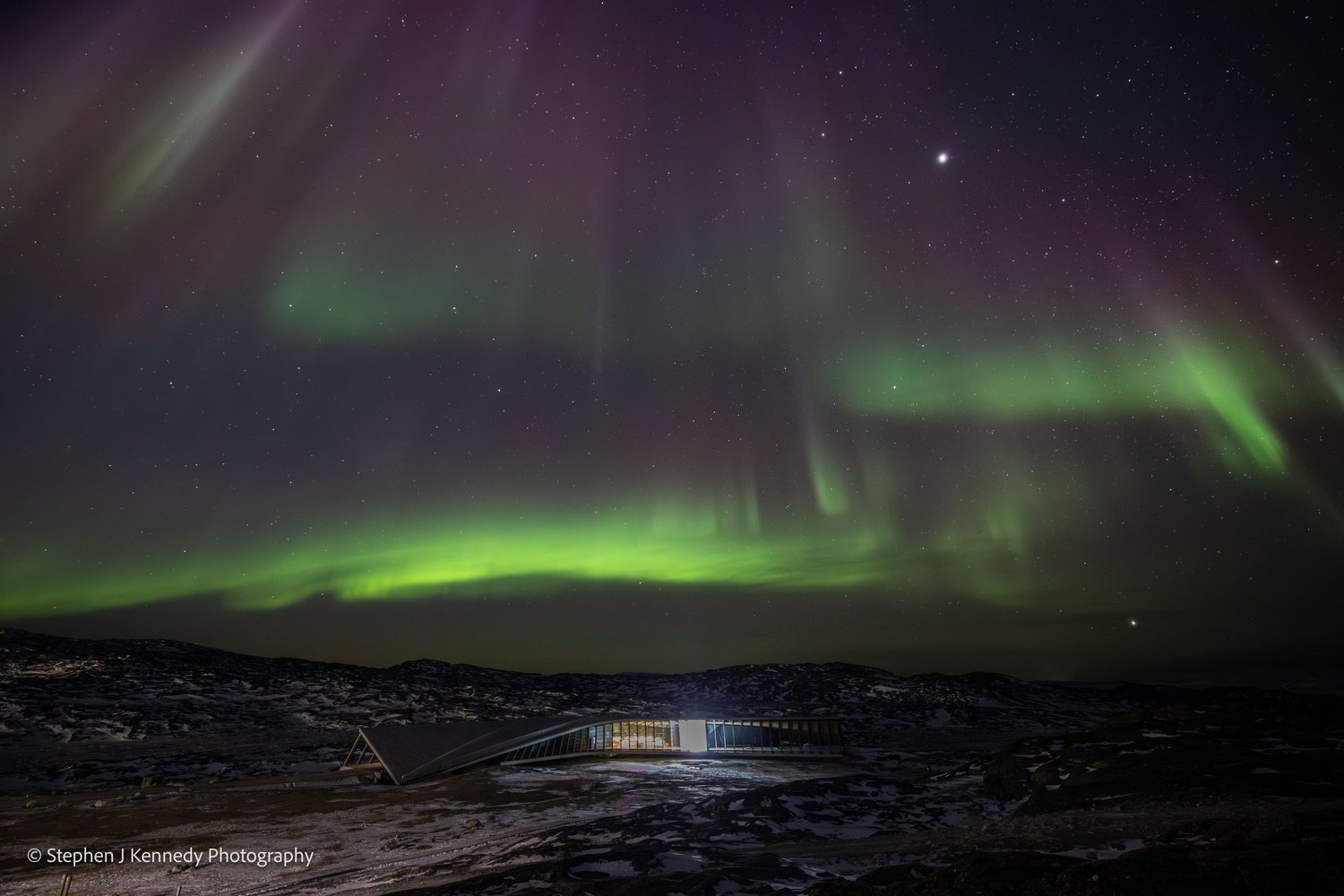
Our photography workshop, (a group of 9 photographers) led by Ollie Taylor began in earnest this evening, with a forecast uncertain enough that any sensible person might have stayed inside. After a short debate, Ollie, and a fellow photographer, Norman and I went out anyway, making our way to the rocks and open ground around the Icefjord Centre — a spectacular vantage point with the great frozen fjord spreading out beyond. At some point in the darkness, a distant iceberg calved with a deep, rolling boom that crossed the water and faded into silence.
Then the dogs began to howl. A faint green shimmer appeared low to the south, and as it gradually strengthened, the cloud overhead began — improbably, almost impossibly — to thin and part. I filed that observation away carefully: don't rely solely on the forecast app. Show up. Watch what the sky does when aurora builds on the horizon, because sometimes the clouds move as if clearing a path for the light.
Disko Bay & Iceberg Fire
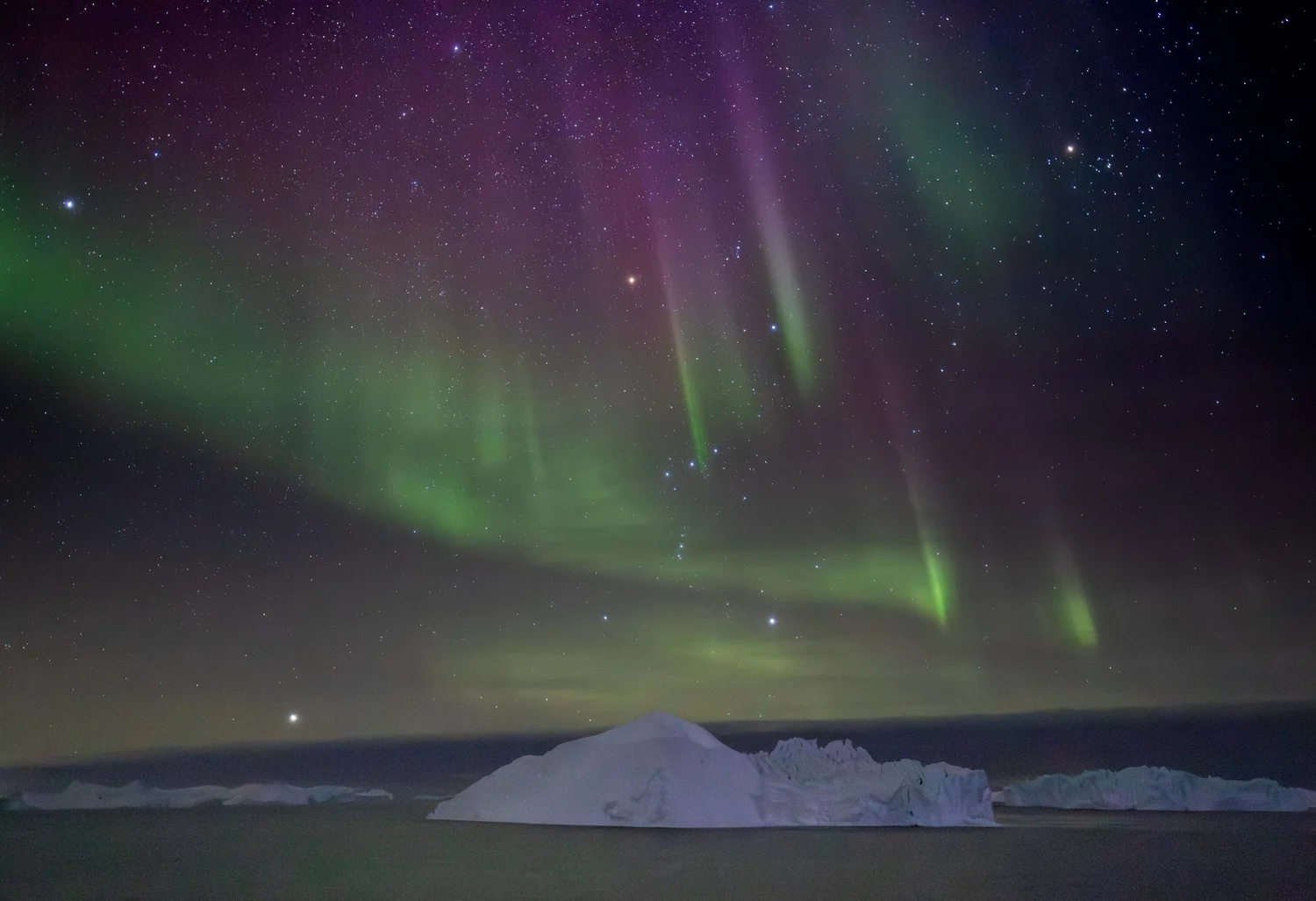
Another walk along the Yellow Trail in the morning, more confident now in how to read the markers and the terrain. The afternoon brought the Icefjord/Disko Bay cruise — a bruising cold on the water, made bearable by the scale of the icebergs drifting alongside us and the incongruous pleasure of local gin poured out among floating giants that dwarfed the boat.
That evening, the cloud again looked discouraging, but given the promise of the previous night, again we walked out anyway. The same pattern unfolded: the dogs stirred, a glimmer appeared to the south, and as the aurora built in intensity, the clouds cleared as though moved by the light itself. From the Blue Trail viewpoint and the lake area, we photographed a full corona directly overhead — green ribbons radiating from a single point above us, as if the sky had opened. Below, the great icebergs locked in the ice fjord glowed in the same green light. It was the best display Ilulissat would offer, and we had nearly not gone out. Photographing northern lights over icebergs is something I will never forget.
Uummannaq — 16–23 February
Helicopter to Uummannaq
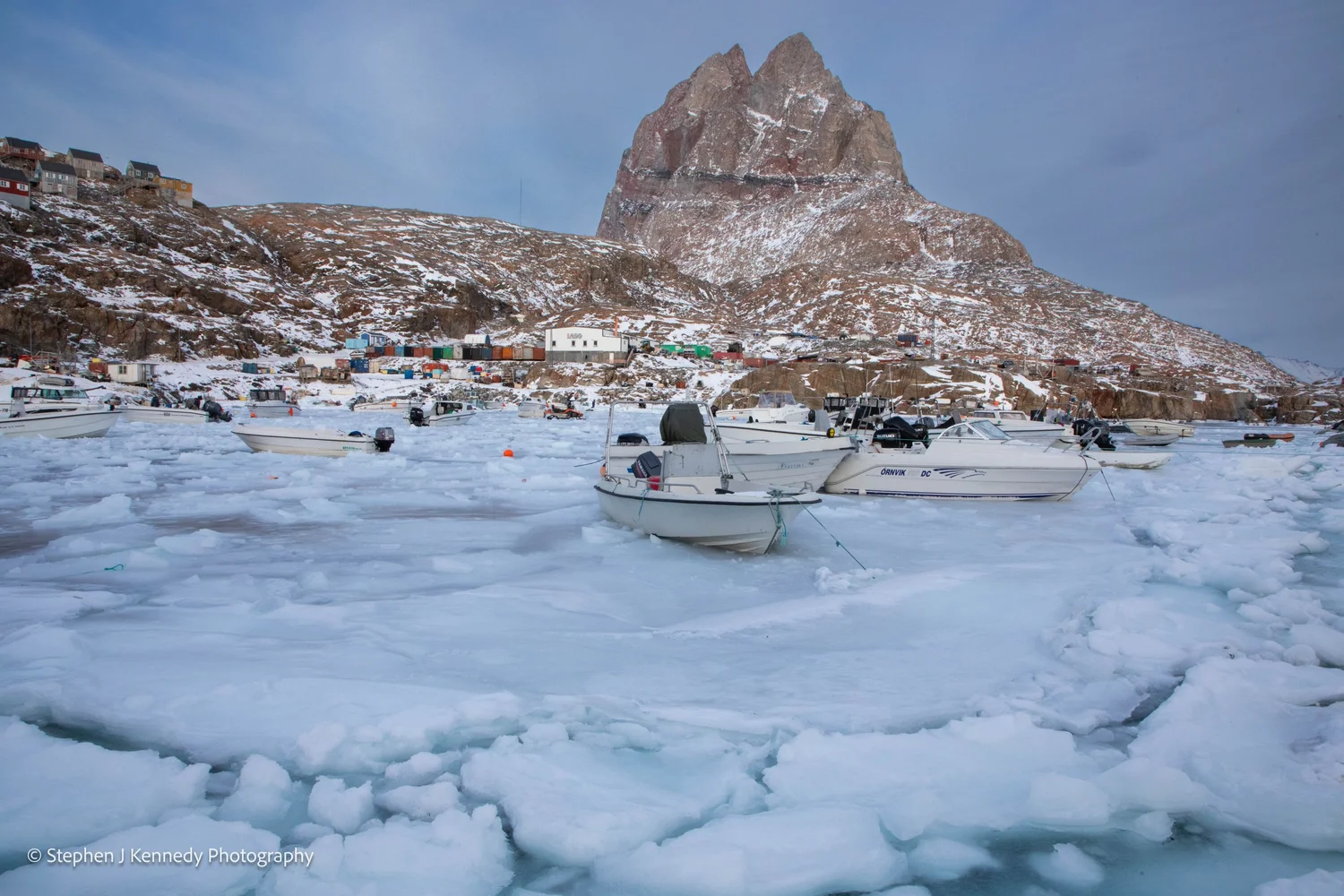
An Air Greenland flight to Qaarsut and then a helicopter onward to Uummannaq — a journey that ended in one of the most arresting arrivals I have ever experienced. Approaching the island at dusk, snow dusted the landscape in a soft blue-grey light and the great Uummunnaq mountain rose ahead of us — immense and cathedral-like, filling the helicopter window. Below, the scattered lights of the small town glowed warmly against the surrounding white of the frozen fjord. It felt, for a moment, like something out of a dream or a fairy tale, and I remember pressing my face against the glass in a kind of quiet awe.
There was no aurora that night — just the anticipation of what the next week might hold.
Red Sunrise
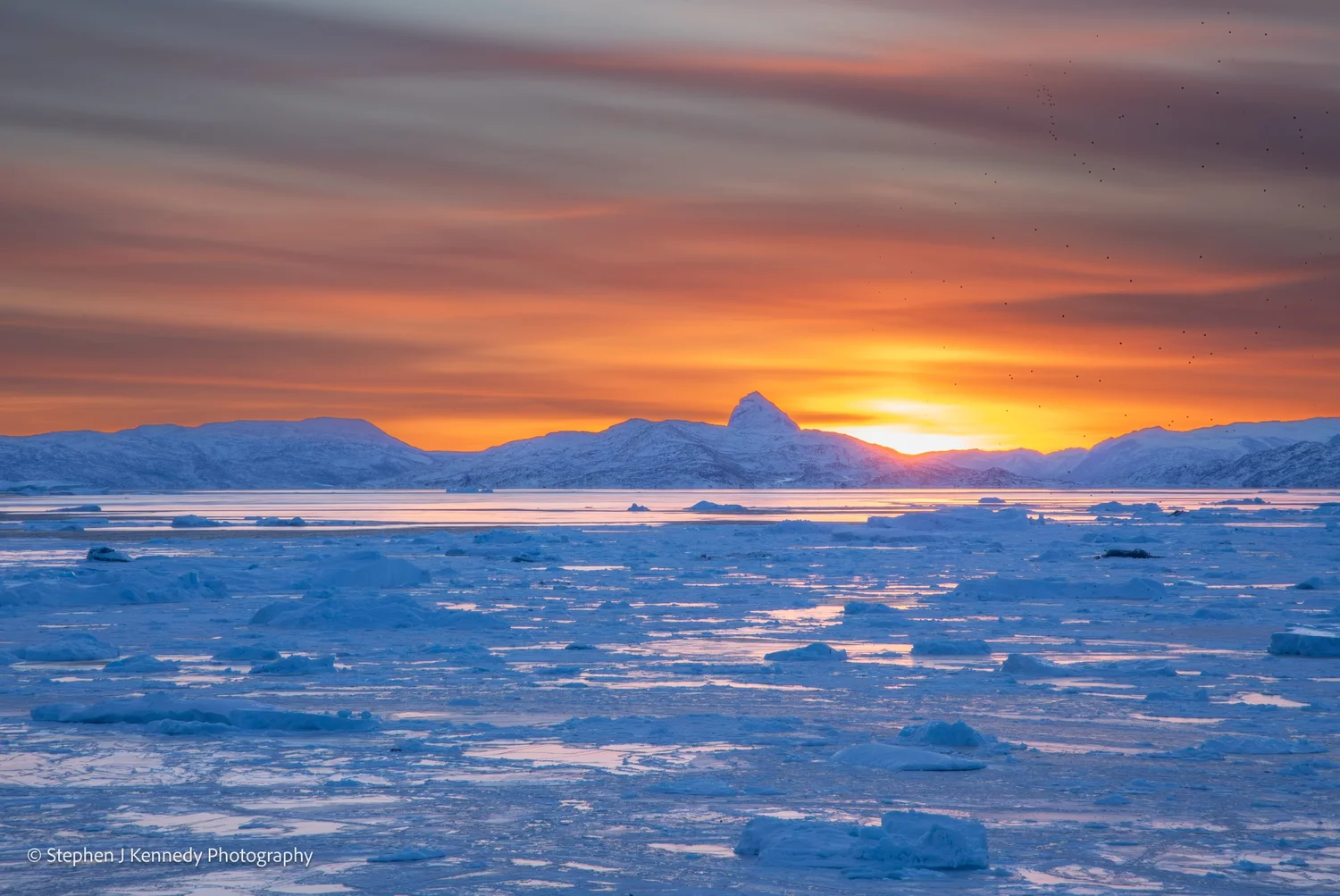
Before the town had stirred, I stepped out onto the apartment balcony and watched the colours of the sky erupt. Crimson and copper hues had spread across the frozen fjord, turning the ice to what looked like hammered copper, and the ridgeline of the mountain above the town was catching the same glow along its edges. After several nights of chasing green light across dark skies, there was something almost overwhelming about this red stillness over the sea-ice — the world transforming quietly while nobody else was watching.
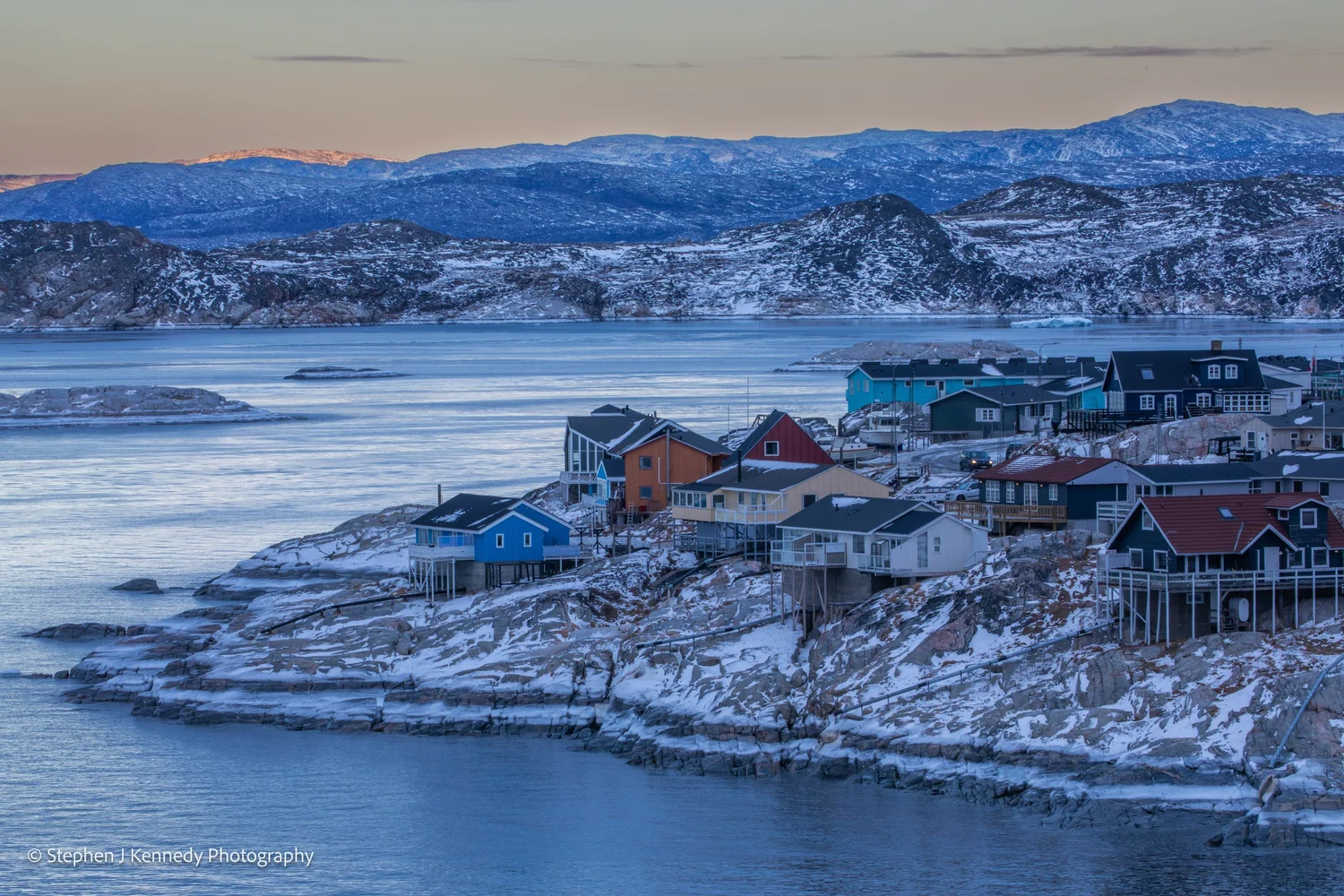
Later in the day I explored Uummunnaq harbour, where sled dogs rested on snow dusted rocky outcrops in clusters and the colourful houses of the town — reds, blues, yellows — stood out vividly against the white of the fjord. Uummannaq felt timeless in a way that Ilulissat, for all its beauty, did not quite manage — smaller, more remote, more entirely itself. Later in the day we paid our first visit to Uummunnaq's Tasersuaq, the lake at the foot of the mountain. It was completely frozen, though my fellow photographers and I still walked precariously on the lake in our spikes. We spent a couple of hours photographing cracks in the ice, and watched a local musher take his pack of Greenland sled dogs around the ice.
Snow & Patterns
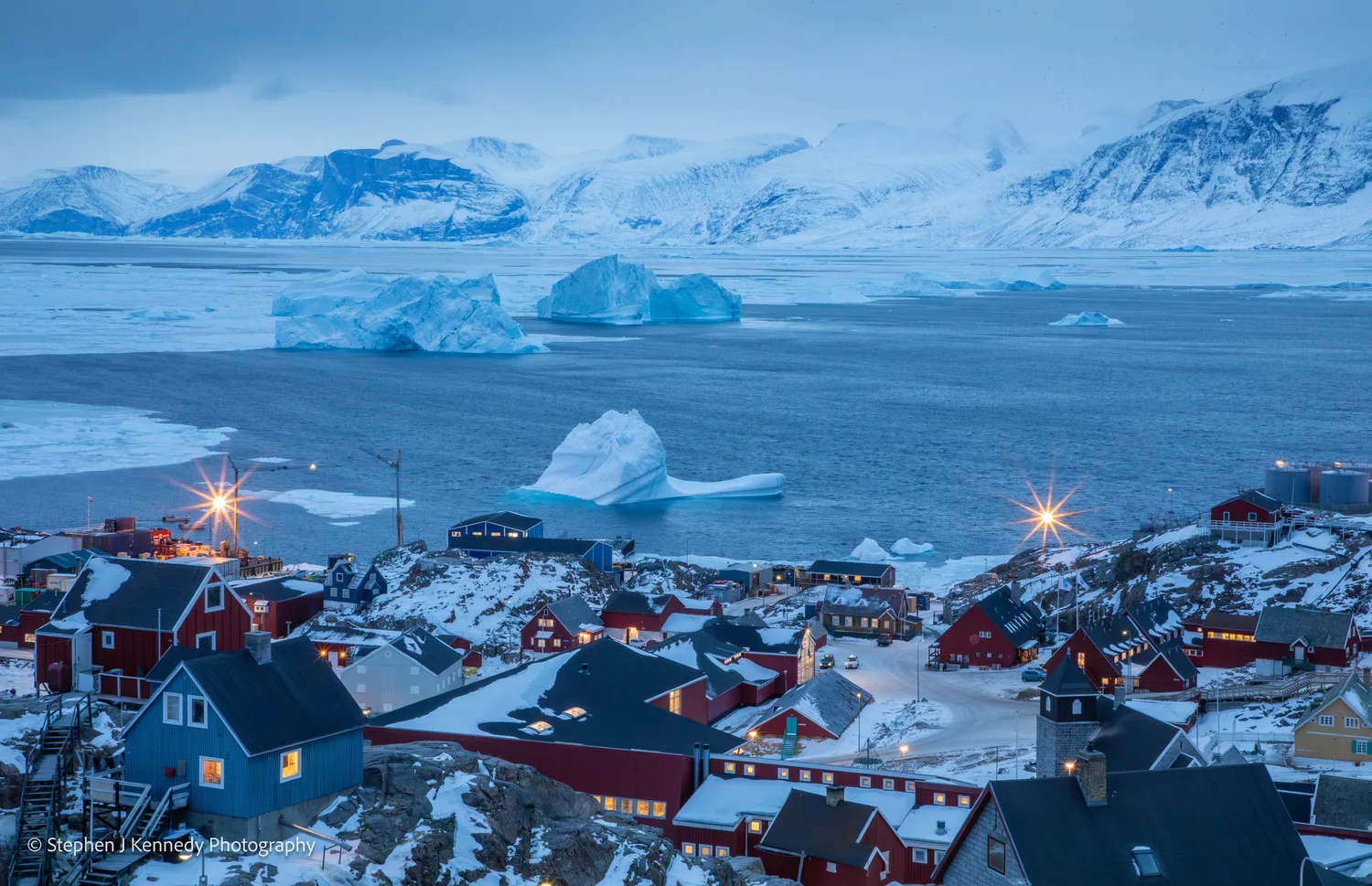
Snow fell softly in the morning, and I spent the early hours photographing around the harbour where the flat, diffused light brought out the colours of the houses in a way that clear skies wouldn't have allowed — each one a small declaration of warmth against the surrounding white. In the afternoon I walked out across Tasersuaq Lake, drawn less by the views than by what the wind had done to the surface of the ice. Pressure ridges, freeze lines, long geometrical patterns left by the movement of cold air — the lake had been doing its own slow photography for months, and the results were extraordinary up close.
By night the temperature had dropped toward −25°C and the snow underfoot had taken on that characteristic squeak that only happens when it's genuinely, seriously cold. Breath crystallised almost instantly. The world had become entirely still.
Harbour Walks in Snow
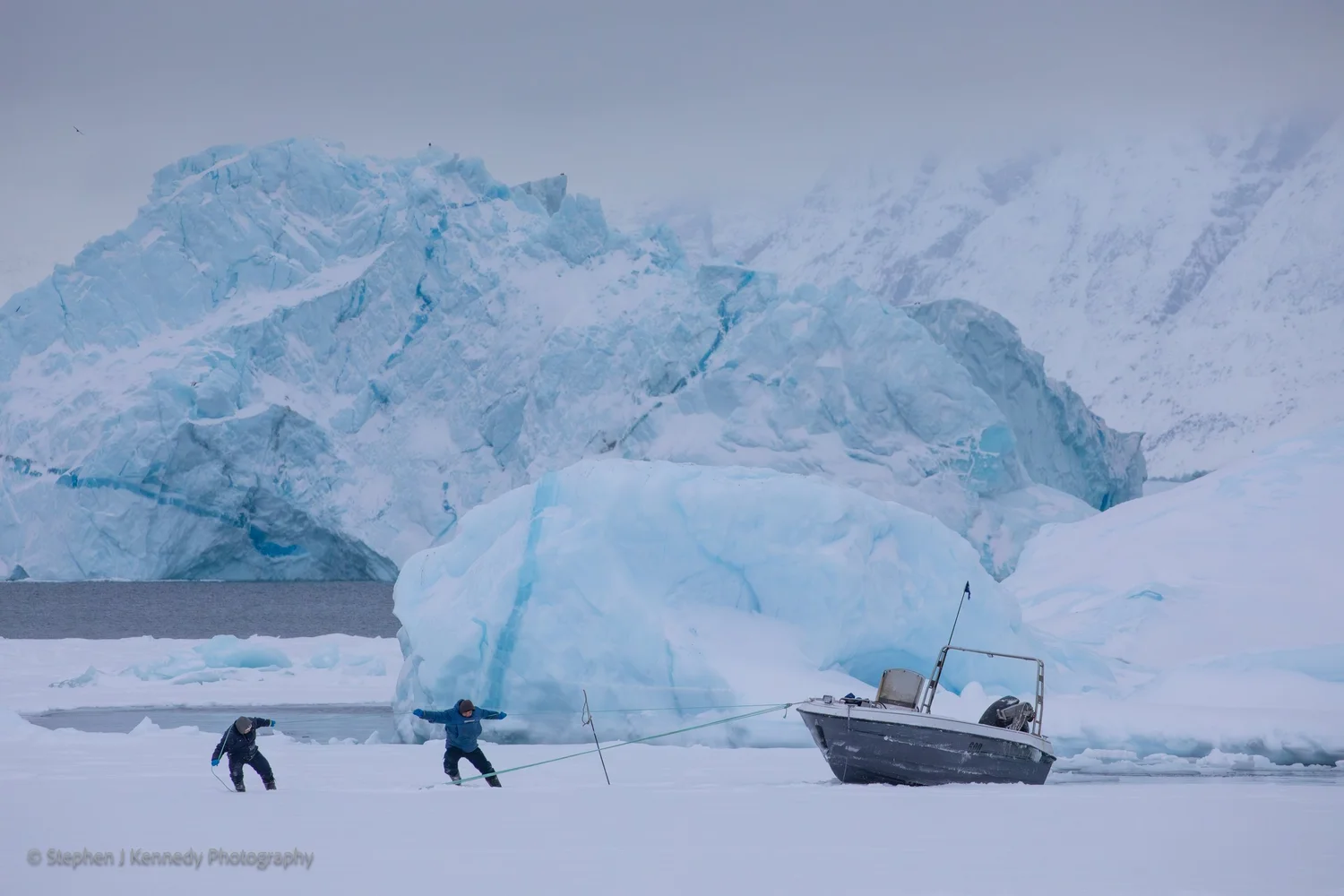
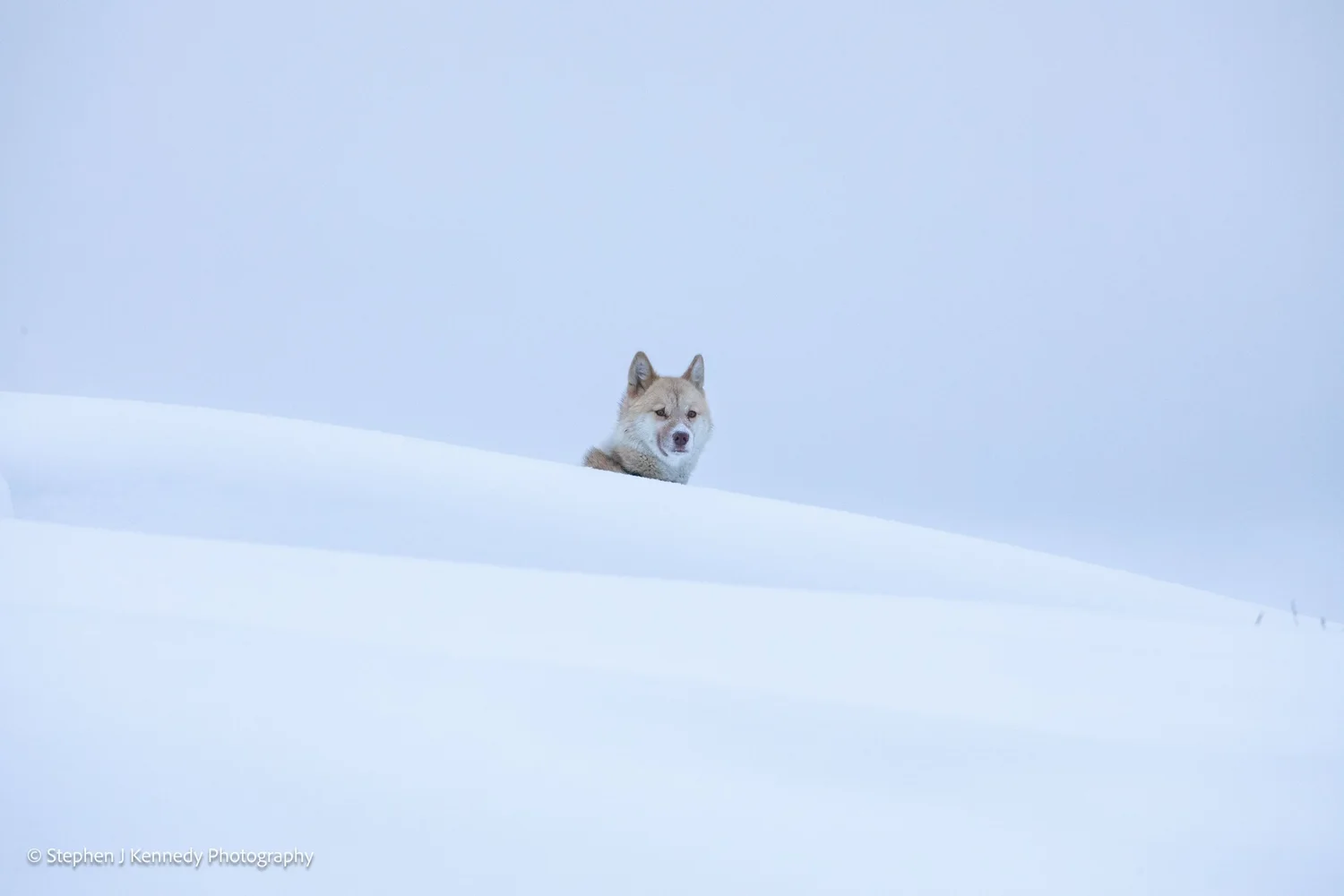
Heavy snow through much of the day, which pushed me back toward the harbour and the simpler pleasures of walking and watching. In the morning I took the telephoto out to photograph the local sled dogs resting in their enclosures, their thick fur already carrying a layer of new snow. Later in the day, walking back along the harbour edge. On the way back down to the harbour, I came across two men in the process of hauling their boat up onto the ice — working together with the practiced, unhurried effort of people who have done this a hundred times before. The scene — the effort, the ice, the snow falling around them, the mountain above — came together into one of the strongest images of the entire trip.
The cold that day was constant but manageable, provided you kept moving and stayed honest about when it was time to go back inside and warm up before going out again.
Disruption
Our Air Greenland helicopter back to Ilulissat was cancelled due to technical issues (either that or the fog settling in across the fjord, which set off a quiet cascade of reshuffled flights and adjusted plans. Our planned 4 days in Uummunnaq would turn into 8, as our helicopter reschedule was moved to Feb 24th. Air Greenland's staff handled the rebooking with a calm efficiency that suggested this kind of disruption was simply part of how things worked here, which in retrospect it was. In a land where weather and logistics are subject to forces entirely beyond anyone's control, adaptability isn't a virtue so much as a basic condition of travel.
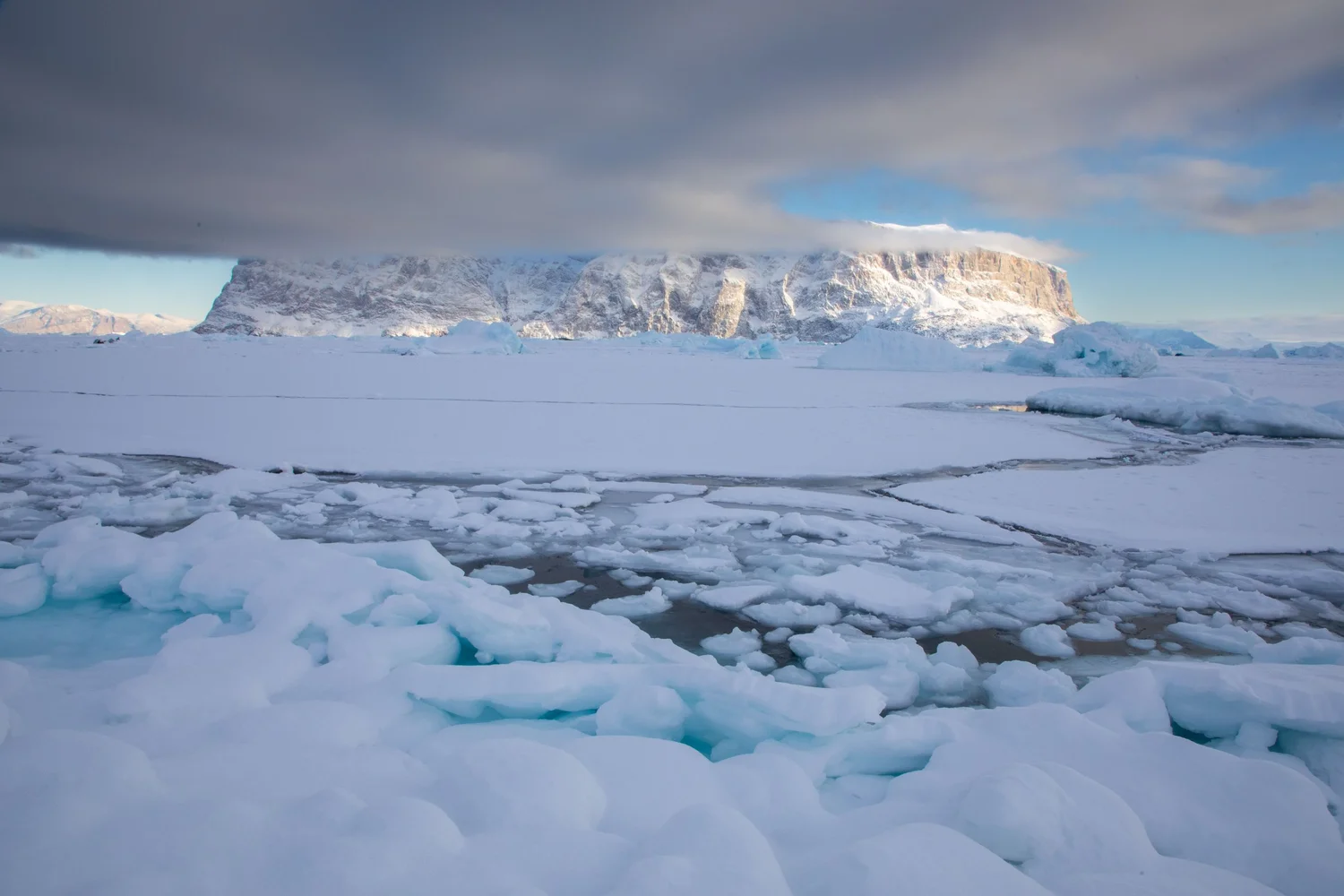
I walked up to the viewpoint above the town and spent time looking out over the fjord — the icebergs motionless, the mountain catching the last angle of the afternoon light — and found myself grateful for the extra day. Disruption, it turned out, was a gift in disguise.
Return of the Light
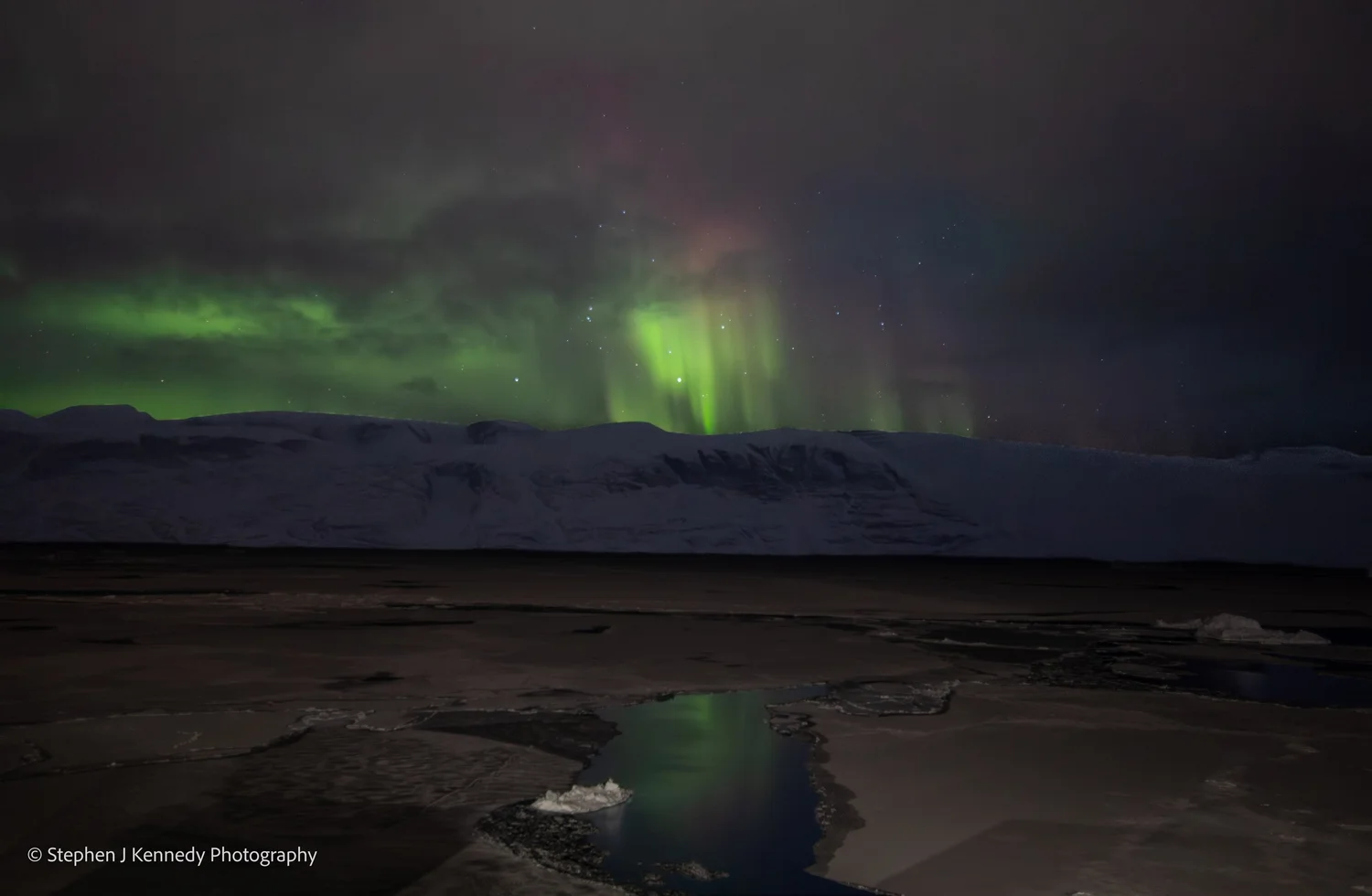
A morning walk across the snow-covered lake and around the iceberg viewpoints — crisp air, soft light, the satisfaction of moving through a landscape that had started to feel familiar. The kind of morning that rewards an early start simply with the pleasure of being there.
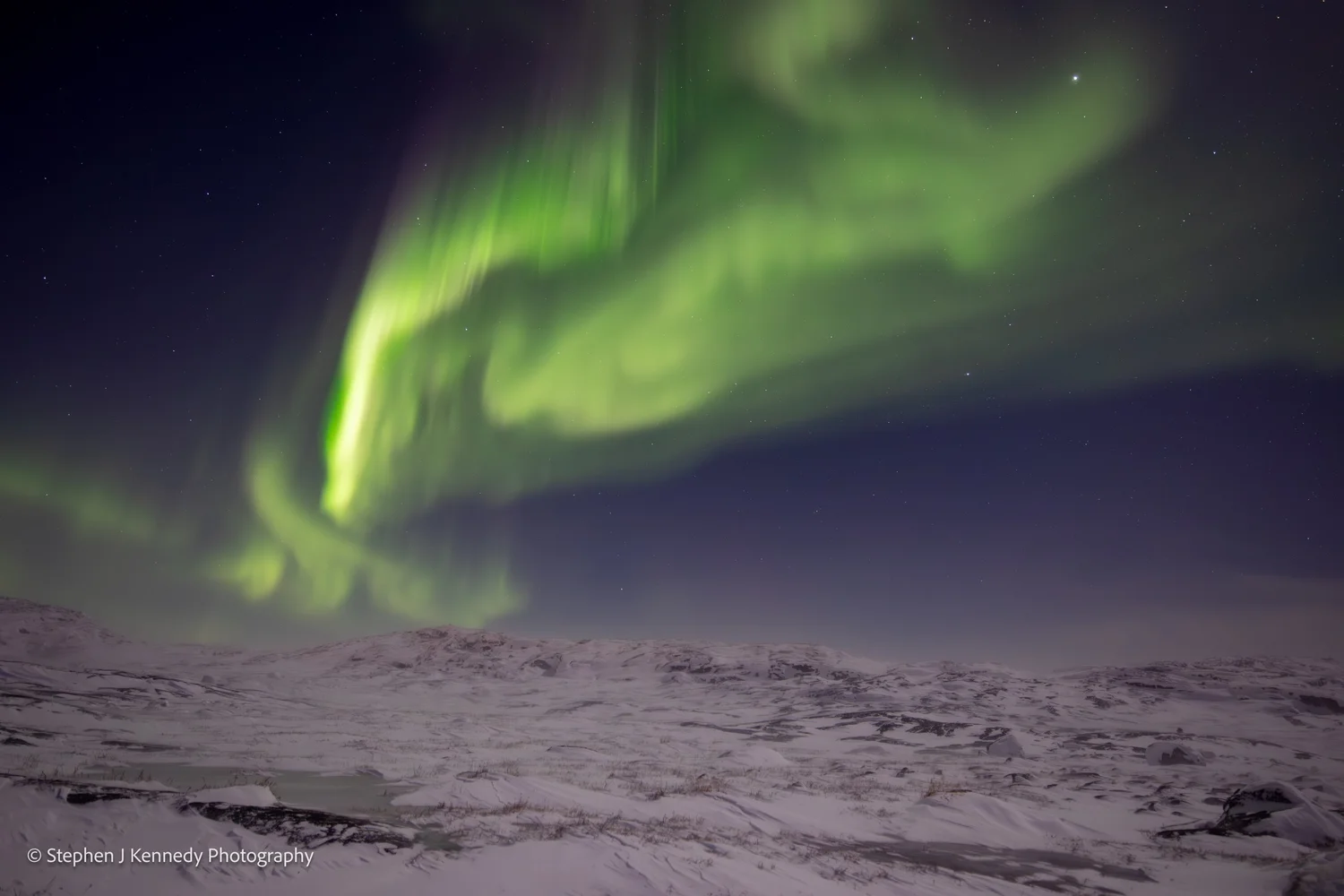
That evening, walking toward the lake, we heard the dogs begin. A faint glow appeared low on the southern horizon and, as it had done before, grew steadily stronger as the sky overhead cleared. Aurora arced above the mountain and the colourful houses of the town, the dogs howling throughout — not the strongest display we would see in Uummannaq, but beautiful in its own quieter way, and welcome after the nights of cloud.
The Night of Persistence
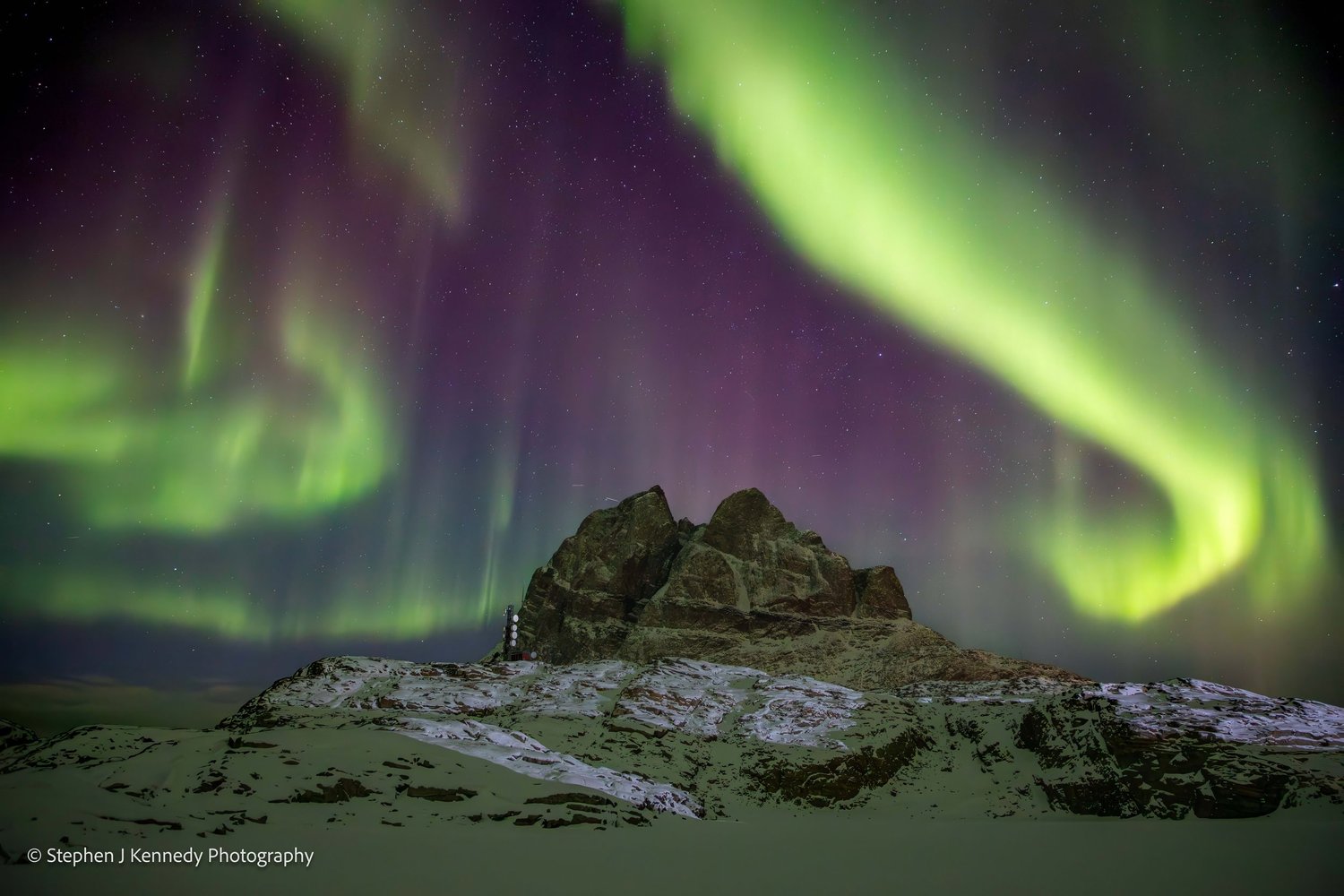
Telephoto work with the sled dogs during the day — the dogs close up are magnificent animals, built entirely for this landscape, and spending time with them felt like a privilege. That night, however, the sky looked overcast again and the temptation to stay in was real. Norman and I went out early to the frozen lake beneath the mountain anyway, and for almost an hour nothing much happened. The cold moved steadily inward through layers that had felt more than adequate when I'd left the apartment, and the sky showed no sign of clearing.
I walked back inside, added more layers, waited for feeling to return to my fingers, and went back out. It would have been very easy to leave it there, to call it a clouded night and move on. The lesson that evening was that persistence, more than any forecast or piece of equipment, is what separates the nights you see something from the nights you don't. Not long after I returned to the lake, the sky erupted into a full corona — green ribbons converging overhead from every direction, the ice groaning faintly beneath our boots, the dogs howling throughout. This was the best aurora of the trip, the aurora starting on the southern horizon over the fjord, then building to a full corona overhead, before descending to the northern horizon behind Uummunnaq mountain.
Reflections on Ice
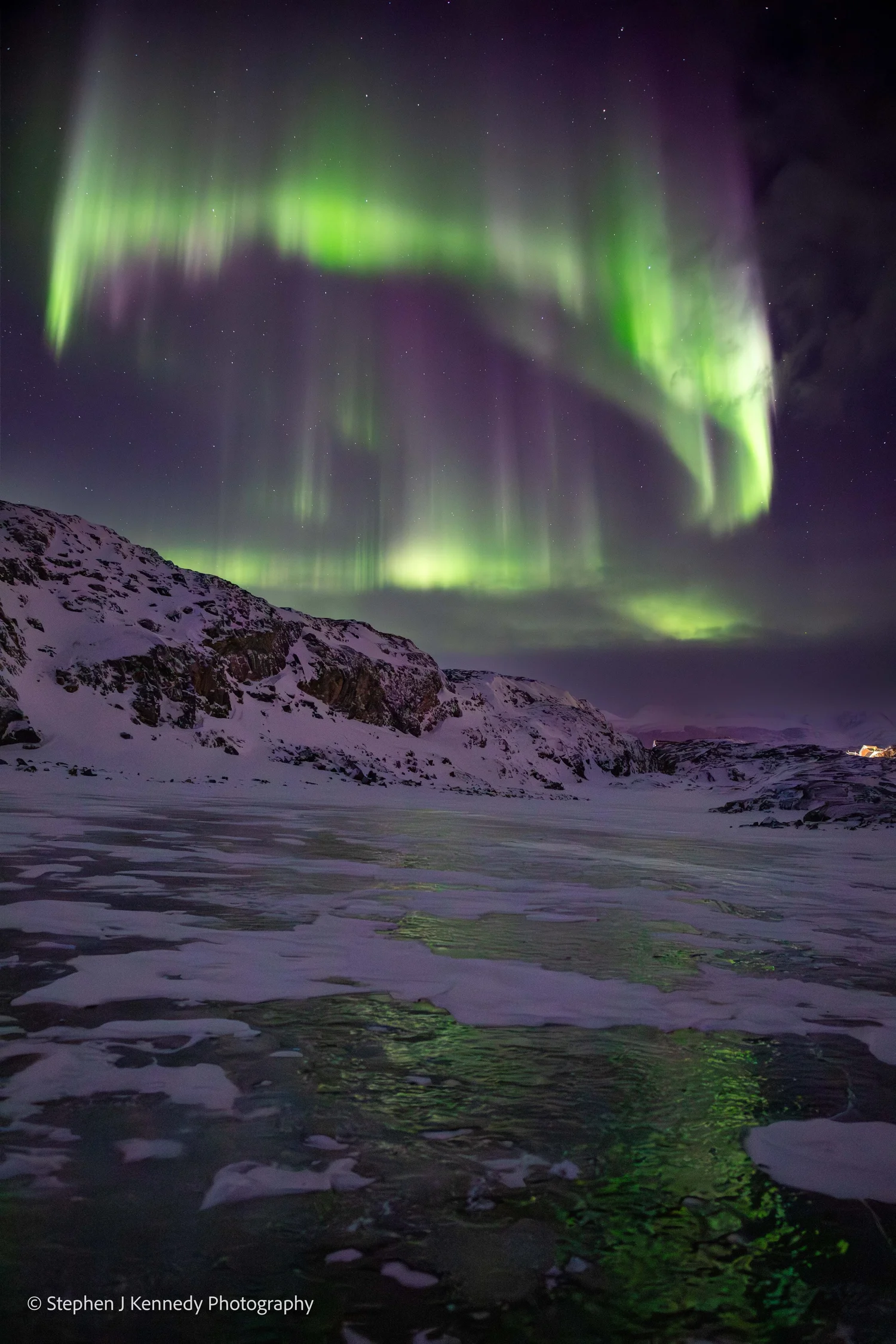
More town photography during the day, moving through the harbour and the quieter streets in soft, cloud-diffused light. That evening, strong aurora returned and the conditions were different from anything we'd seen so far — the wind had swept the snow entirely off the surface of the lake, leaving the ice clear, and as the aurora built overhead it cast a perfect reflection below us. Green light mirrored on ice, the mountain framing the scene on one side, the dogs beginning their chorus before the intensity peaked. Another magnificent night in Uummannaq, for the simplicity of what it offered: just light, ice, and reflection.
Qaarsut & Ilulissat — 24–27 February
Helicopter Negotiations
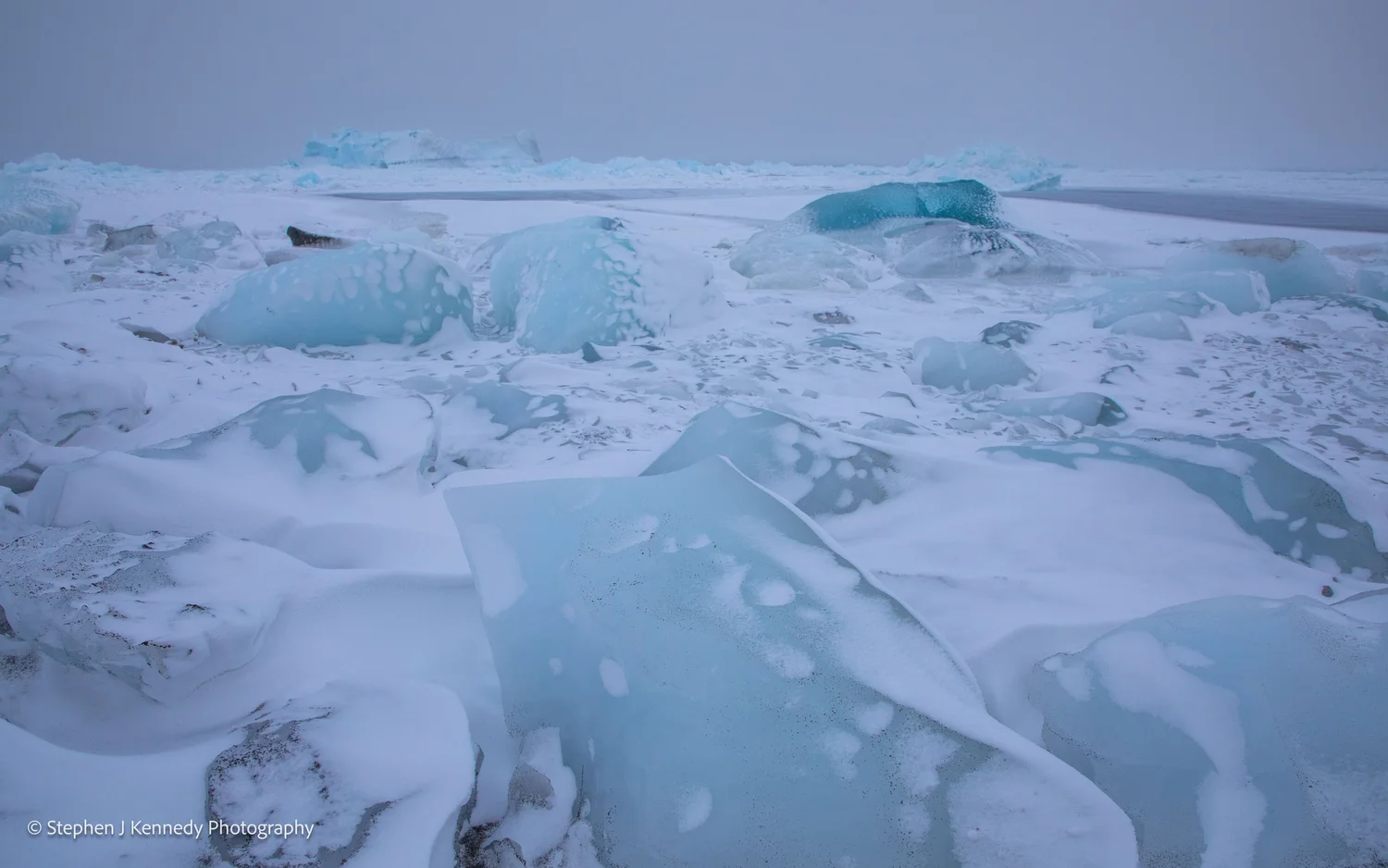
We waited several hours at the Uummannaq heliport, and alas the flight to Ilulissat cancelled due to poor visibility there. Ollie eventually negotiated a helicopter to Qaarsut instead, where the weather was clearer, and the relief of getting moving again after hours of waiting was considerable. The 15-minute flight down the fjord was tense and extraordinary in equal measure — the landscape below stark, misty and beautiful and entirely indifferent to whatever plans we might have had.
After arrival, Ollie, Norman and I set off on a 3.5km walk along the frozen fjord to the Air Greenland airport hotel followed, the wind chill well into the −30s and the cold making itself felt through every layer. But the hotel staff in Qaarsut, faced with an unannounced arrival of stranded travellers, responded with a warmth and generosity that made the whole experience memorable for entirely different reasons — cooking for us, making sure we were comfortable, treating us less like unexpected guests and more like people they'd simply been expecting. It was a reminder that in Greenland, community is not an abstraction.
Brutal Wind in Ilulissat
Morning photography around the small settlement of Qaarsut — quiet, sparse, functional, the kind of place that exists entirely on its own terms and makes no concessions to visitors. A flight to Ilulissat followed, with Air Greenland arranging accommodation at the Icefjord Hotel.
That night we went out for aurora in conditions that crossed the line from challenging into genuinely hostile — snow driving horizontally across the fjord, a wind chill near −34°C. My snood froze solid from the moisture in my breath within minutes of stepping outside. The air burned any exposed skin it found. The aurora was there but the conditions made meaningful photography nearly impossible, and we abandoned the attempt early. There are nights when the landscape simply wins.
Whiteout
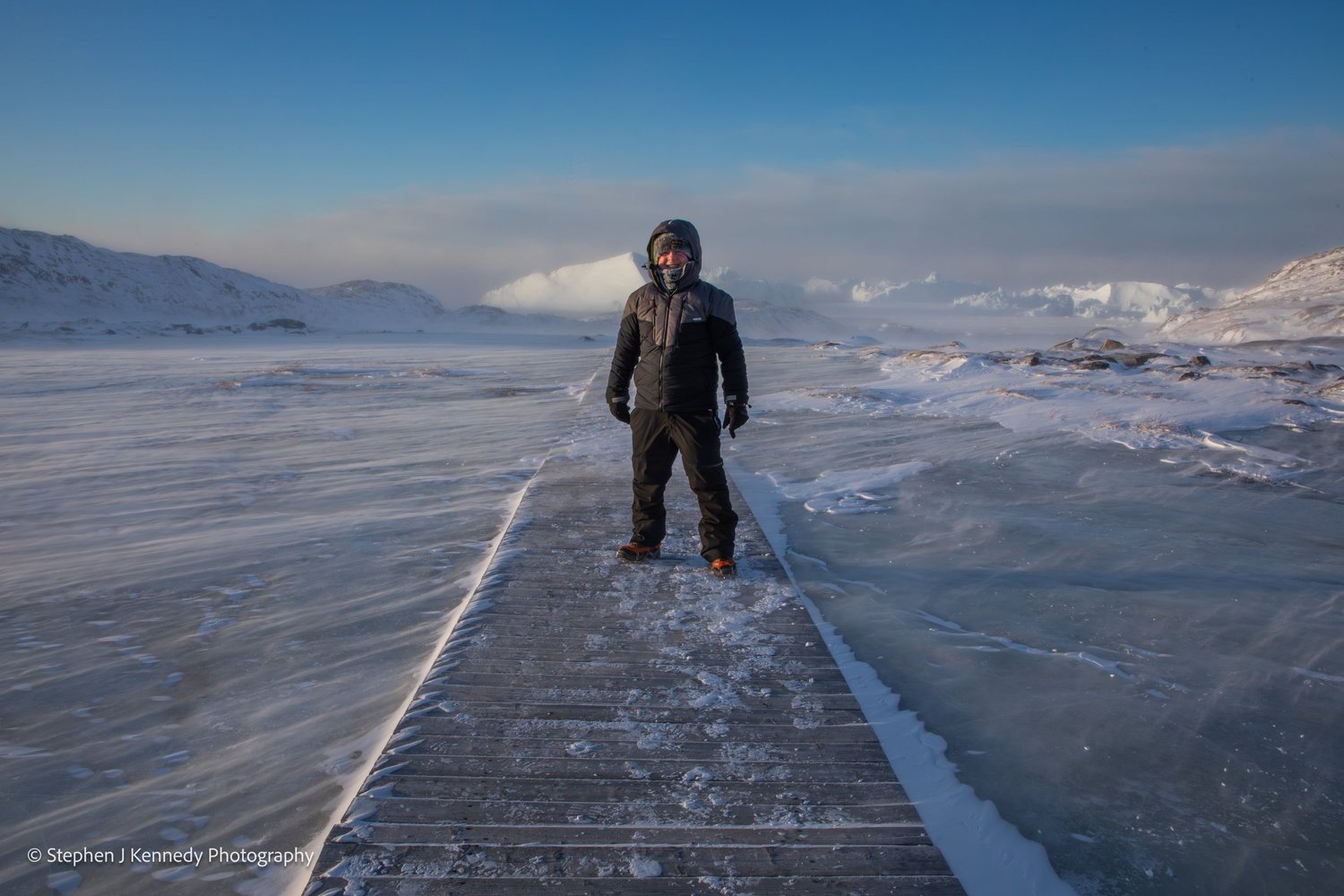
A morning walk toward the Icefjord Centre the following morning was its own ordeal — gusts whipping snow across glazed ground, my eyelashes freezing together, the beanie iced over, even the fine hairs inside my nose stiffening with each breath.
And later in the afternoon, an attempted flight to Nuuk ended on the runway. Snow was blasting across the tarmac and the plane taxied, held its position for twenty minutes, and then surrendered — turning back to the terminal in the face of a full whiteout, the wind chill down to −44°C. We ran back across the tarmac in conditions that felt more like a natural event than a weather forecast, and the sight of our breath being immediately torn away before it could form summed up the morning.
The Greenlandic people navigated it all without drama: hotels were arranged without complaint, flights rebooked without fuss, stranded travellers taken care of as a matter of course. Throughout every disruption of the trip, their warmth and practical generosity never wavered.
Moonlit Aurora
Calmer weather, finally, and another walk along the Blue Trail that felt like a reprieve after days of battle with the elements. The icebergs in daylight were extraordinary — towering, sculpted shapes that the sea and the cold had been working on for centuries, each one unique. I photographed from the boardwalk and the viewpoints in a kind of gratitude, simply glad to be moving freely through a landscape that had been denying that freedom for the past two days.
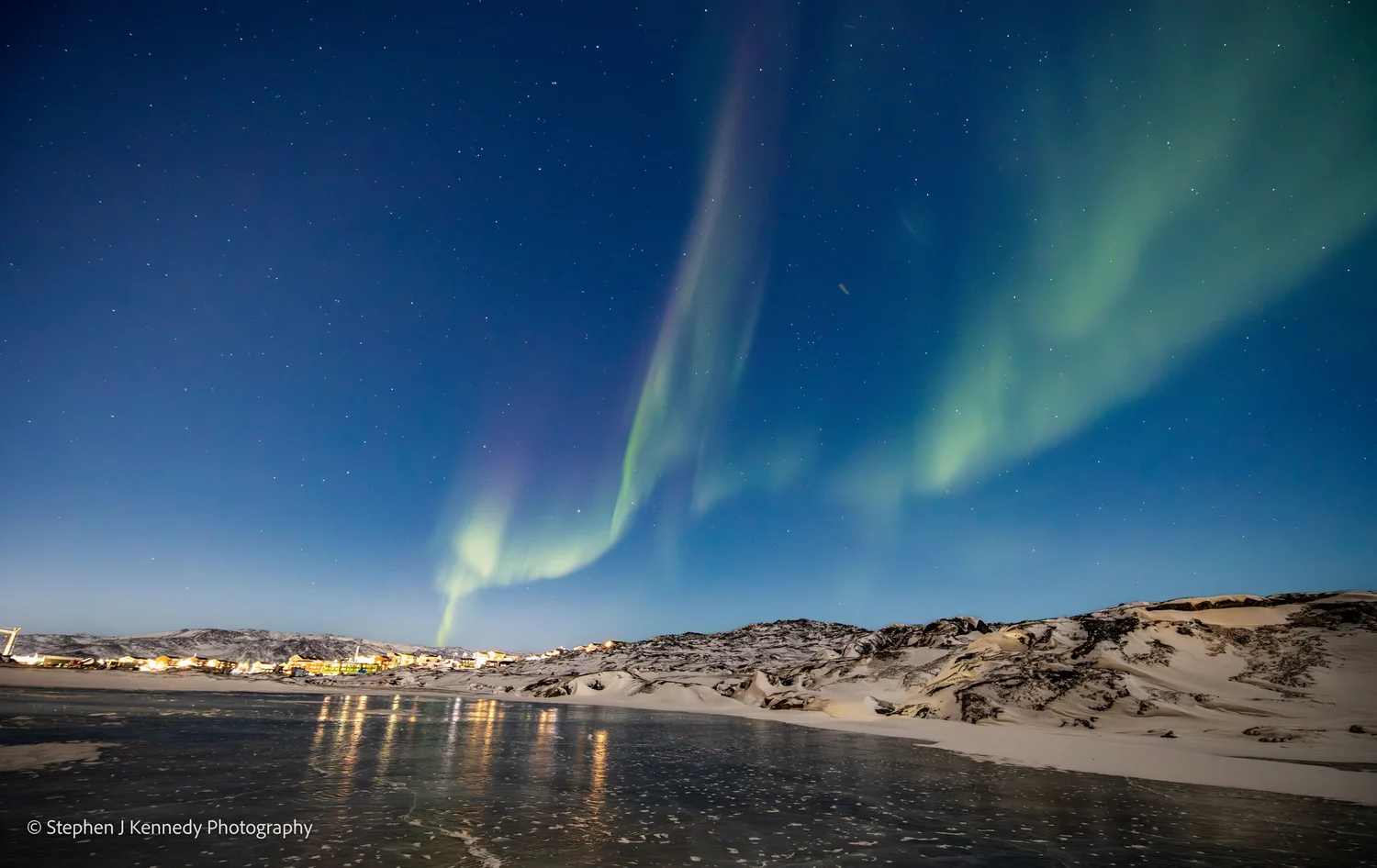
That night, the aurora came washed pale and softened by a full moon — not the intense displays we'd had in Uummannaq, but beautiful in a different register, the light gentle and diffuse across the snow. The sled dogs howled before it strengthened, as they always seemed to do, and the sound carried across frozen ground in the still air — primal, timeless, and now deeply familiar.
Nuuk & Home — 28 February – 2 March
South at Last
My morning was spent processing timelapse sequences and reviewing images from the weeks before — a strange, suspended kind of time in which the trip existed simultaneously in the past as memory and in the present as files and folders. Then the flight to Nuuk, which went without incident, and a 5km walk along the Greenland capital's boardwalk that felt almost disorienting after so long in smaller, quieter places. Nuuk is larger, busier, more connected — a different Greenland entirely, and one that made the contrast with Uummannaq and Ilulissat all the sharper.
Already, walking back through the city, I found myself missing the particular silence of the frozen fjord and the sound of the dogs in the dark.
Homeward
Nuuk to Reykjavík, Reykjavík to Copenhagen — the journey home unfolding in the way such journeys do, each flight a small surrender of the thing you've just been part of. The flights were reshuffled again, though by this point the flexibility had become second nature. A layover in Copenhagen gave me several hours to sit with the images and the memories together, replaying moments that already felt both very recent and very far away — the red sunrise turning ice to copper, the corona erupting directly overhead, the dogs beginning their howl in the moments before the light appeared.
Return
Copenhagen to Gatwick, and home. Greenland receded into the distance with each kilometre, but the sound of ice cracking underfoot and the howling of the dogs in the moments before the sky opened — those did not recede at all.
Reflections
I had come to photograph aurora borealis. What I found instead was a landscape that demanded a kind of apprenticeship — one that couldn't be rushed or negotiated with, only accepted on its own terms.
Ice that spoke. Dogs that knew before the sky opened. Cold that taught a respect for the body's limits. Weather that ruled everything, absolutely and without appeal.
Over three weeks I hiked 123km across Arctic terrain, ascending 3,132m through ice fields, frozen fjords, and mountain trails — every step recorded in Strava, every hike a lesson in reading a landscape that was constantly, quietly communicating with anyone willing to pay attention.
And then there were the ten nights of green light — over frozen lakes, over icebergs, reflected back from ice cleared by the wind. Each one earned by showing up despite the forecast, by adding another layer and going back out, by choosing to trust the dogs over the app.
What also stays with me vividly is the warmth of the Greenlandic people encountered throughout — in the Ilulissat Icefjord centre, heliports and hotels and a small settlement called Qaarsut where staff cooked for a group of stranded strangers without hesitation and made us feel, in a place that had no reason to, entirely welcome. In a land where survival has always depended on community, that generosity felt less like hospitality and more like something structural, something built into how people relate to one another here.
Greenland teaches attentiveness. It rewards persistence. And it doesn't negotiate. A trip of a lifetime. Qujanaq, Greenland!
My thanks to Ollie Taylor for leading a memorable photography workshop, and to Norman, Gavin, Sandy, John, Sally, Amanda, and Cat for being such wonderful companions on the journey.